What's ketamine psychedelic therapy like? Reviewing 5 years of real-world practice data

 Michael DeMarco, PhD
Drafts ongoing.
Psychedelic is the word given to describe any medicine or practice that can lead to an inner experience described in English as altered states of consciousness. Ketamine is a generic medication used in humans and animals since 1962, and is often described as involving this psychedelic experience. In very high doses, it has been safely used as surgical anesthesia within an anesthetic class described as "dissociative anesthesia" since it was approved by the FDA in 1970. It has a long history of being prescribed off-label for a range of pain and mental health indications.
I began specializing in ketamine therapy and facilitation as a psychedelic therapist in 2021. I developed a program to train others in cognitive-behavioral mental health, both in-person and virtually, to support the experience of the therapeutic use of ketamine for pain and mental health indications.
This is what journey reports reveal after 5 years of practice.
Mystical Experiences in Ketamine Therapy (2021–2026)
Total Sample Size: n = 177 individual ketamine therapy journeys
Complete Category Breakdown
| Category / Element | Journeys | Percentage (n=177) |
| Visual and sensory phenomena | 103 | 58.2% |
| Positive changes in attitude and behavior | 100 | 56.5% |
| Deeply felt positive mood | 94 | 53.1% |
| Transcendence of time and space | 91 | 51.4% |
| Internal unity | 90 | 50.8% |
| Objectivity and reality | 75 | 42.4% |
| Ineffability | 72 | 40.7% |
| Altered time perception | 64 | 36.2% |
| Transitoriness | 61 | 34.5% |
| Sense of the sacred | 57 | 32.2% |
| External unity | 53 | 29.9% |
| Understanding of bodily processes | 53 | 29.9% |
| Paradoxical character | 49 | 27.7% |
| Cognitive phenomena | 41 | 23.2% |
| Sense of evolutionary processes | 25 | 14.1% |
| Childhood regression / Life review | 20 | 11.3% |
| Bright white light / Electric currents | 20 | 11.3% |
| Nausea / Tachycardia / Contractions | 14 | 7.9% |
| Psychotic phenomena / Disorientation | 9 | 5.1% |
| Sense of telepathy or clairvoyance | 8 | 4.5% |
Pahnke and Richards defined the psychedelic/mystical experience using core categories derived from Walter Stace's phenomenology of mysticism. In this dataset from 5 years of private practice, several of these core dimensions rank exceptionally high:
- Transcendence of time and space: 91 mentions (8.28% of total tags)
- Internal unity: 90 mentions (8.19% of total tags)
- Objectivity and reality (noetic quality): 75 mentions (6.82% of total tags)
- Ineffability: 72 mentions (6.55% of total tags)
These same subscales were initially used to measure whether participants undergoing high-dose LSD sessions achieved a "complete mystical experience."
The ketamine dataset from 5 years of private practice in ketamine therapy shows a strong concentration in these specific categories, indicating that ketamine is capable of producing the profound ego dissolution, boundary loss, and noetic perceptions traditionally associated with classic serotonergic psychedelics like LSD or psilocybin.
Pahnke and Richards emphasized that what has now become known as a "mystical experience" produces positive and significant after-effects rather than mere transient confusion or dissociation.
This ketamine data shows:
- Positive changes in attitude and behavior: 100 mentions
- Deeply felt positive mood state: 94 mentions
Although ketamine is technically classified pharmacologically as a dissociative anesthetic (acting primarily as an NMDA receptor antagonist rather than a 5-HT2A receptor agonist like LSD), Pahnke and Richards' theoretical framework is phenomenological. That means it evaluates the subjective state of consciousness achieved rather than the specific neurochemical circuitry involved. What is the EXPERIENCE you have when you work with a psychedelic medicine or practice?
This data demonstrates that, on a functional level, ketamine journeys traverse much of the same psychological territory (described as unity, transcendence, the sacred, and ineffability) that Pahnke and Richards charted for classic psychedelics, like LSD in their 1966 work in experimental mysticism.
That same year Corssen G., Domino E. F. (1966). Dissociative anesthesia: further pharmacologic studies and first clinical experience with the phencyclidine derivative CI-581, which we know now as racemic ketamine. It was Domino's wife, Toni, who proposed the term "dissociative anesthetic" to describe ketamine, deftly avoiding the cultural baggage surrounding other molecules described as psychedelic. Ketamine was then approved in 1970 by the American health authorities (Food and Drug Administration, or FDA) as what was called a "dissociative anesthetic" for primary indications in pain and anesthesia. Studies continued over 60 years, as billions of doses of ketamine have been in administered in a variety of settings for a number of off-label therapeutic indications. Unfortunately, this medicine is subject to misuse which can lead to harm and suffering. When used as a medicine, in clinic, or at home, or other setting, ketamine also reduces a lot of harm and suffering. This tension runs throughout medicine.
In 2014, Kolp and fellow researchers write:
"In addition to its anesthetic and dissociative properties, ketamine also boasts a multitude of other psychological and pharmacological properties, including analgesic, sedative, neuroprotective, anxiolytic, antidepressant, stimulant, euphorigenic, and hallucinogenic effects. The literature on the clinical application of ketamine psychedelic psychotherapy (KPP) is thoroughly reviewed, practical advice for its use is provided, and the pharmacology and phenomenology of ketamine-induced psychedelic experiences are explored, including in relation to transpersonal healing and possible iatrogenic consequences of the misuse of KPP"
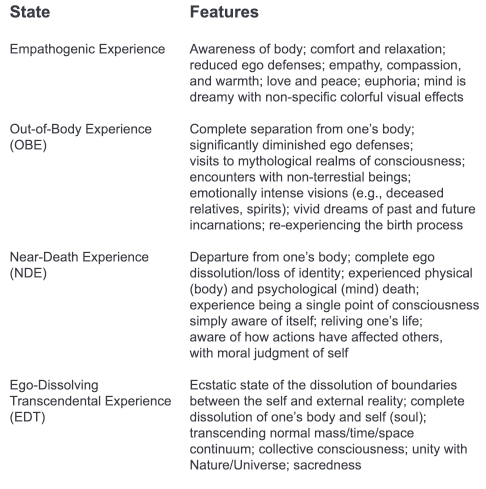
They go on to describe four types of ketamine psychedelic experiences as Empathogenic, Out of Body (OBE), Near Death Experiences (NDE), and Ego-Dissolving Transcendent experiences.
In 5 years of practice, only 7 people had an experience that was different than the four experiences described in research. (Kolp et al., 2014).
Total Sample Size: n = 177 journeys (Period 2021–2026)
| Type of Experience | Journeys | Percentage (n=177) |
| Empathogenic | 144 | 81.4% |
| Out-of-Body Experience (OBE) | 68 | 38.4% |
| Ego Dissolution | 53 | 29.9% |
| Near-Death Experience (NDE) | 23 | 13.0% |
| Without such experience | 7 | 4.0% |
Routes of Administration
- Total Ketamine Journeys 2021-2026 assessed: n=207
Distribution of Routes of Administration
| Route of Administration | Set 1 | Set 2 | Set 3 | Totals | Percentage of Total |
| IV Ketamine | 5 | 0 | 47 | 52 | 25.1% |
| Oral Route | 54 | 15 | 45 | 114 | 55.1% |
| Suppository | 12 | 0 | 2 | 14 | 6.8% |
| Intranasal | 12 | 0 | 2 | 14 | 6.8% |
| Intramuscular Injection | 12 | 1 | 0 | 13 | 6.3% |
Patient Feedback and Safety Outcomes
- Set 1 Results:
- Useful: 57 (90%) Yes, 6 (10%) No
- Self-Harm Thoughts: 100% No thoughts
- Useful: 57 (90%) Yes, 6 (10%) No
- Set 2 Results:
- Useful: 15/15 (100% Yes)
- Self-Harm Thoughts: 100% No thoughts
- Useful: 15/15 (100% Yes)
- Set 3 Results:
- Useful: 90 Yes, 1 No (93 responded)
- Self-Harm: 90 (93%) No, 7 (7%) Yes (within the last 6 months, prior to treatment)
- Useful: 90 Yes, 1 No (93 responded)
- Combined Total Results:
- Useful Session: 162 Yes, 7 No (~90% Positive Responses)
- Self-Harm Thoughts: 197 No, 7 Yes (existing prior to treatment)
- Useful Session: 162 Yes, 7 No (~90% Positive Responses)
After ketamine therapy, people marked whether they thought ketamine was right for them. This was collected from 2 sets of client and trainee cohorts with one practitioner, and a smaller set, third cohort with a practitioner apprentice and clinical fellow, Dominique Condeveau.
The ketamine medicine session was helpful for me: in 162 journeys, people marked Yes, in 7, journeys, people marked that they did Not think that medicine session was helpful. Sometimes this field wasn't completed.
These scores reflect an individual medicine session, and not ketamine therapy overall. Journey satisfaction is sometimes affected by technical difficulties, or journey expectations, as well as how the individual is feeling in the days following the journey at the time of completing their integration questionnaire. Psychedelic integration questionnaires include a qualitative section asking about the most positive aspects and negative aspects of their medicine session, still to be analyzed.
Samples: What was the most negative or difficult part of your experience? Stuffy nose afterward.
What was your intention before taking the medicine? How did your experience reflect your intention? How have you been incorporating this into your daily life?Wanting to see if a low dose would bring back or repeat past journeys. I am reminded by the experiences after the journey by the music I listen to again, after the journey.
What were you able to remember, carry forward, and/or complete that you had intended in your treatment? Yes, I am reminded and aware of being all - all the time. Tremendous responsibility and blessing at the same time.
What visions or information were you able to bring home to your community about your medicine work? Try being God for a day - just for a day!
Ketamine clients and trainee questionnaires reported 197 No thoughts of self harm currently or within the last 6 months, and over the 5 year period, 7 instances of thoughts of self harm within the last 6 months, although noted that this was pre-treatment with ketamine.
14 experiences over five years were reported with Nausea, Increased Heart rate (Tachycardia) or stomach contractions (amounting to a little over 1 % of the time). Psychotic phenomena / Disorientation was marked 9 times (See fuller definition of these terms in the above, as these are commonly seen effects in other psychedelic medicines.
Within the context of psychedelic-assisted therapy, these effects were within normal range of effects as represented in decades of studies. Many of these areas are captured in the HRS, discussed below.
Edits and analysis ongoing.

 Eli Kolp
Hallucinogenic Rating Scale v 4 (HRS) - Analysis of 66 ketamine therapy journeys
Hallucinogenic Rating Scale v 4 (HRS) - Analysis of 66 ketamine journeys
Select any of the 125 survey items to view response distribution percentages (N = 66).
The HRS version 4 was completed within 1-4 days of ketamine therapy spanning 66 sessions. Although analysis is ongoing, here are some quick takeaways.
- 75% of journeys scored 3 or higher on Q3. Transcendence of Time and Space
- 85% of journeys scored as 3 or higher on Q31. Awe, Amazement
- 56% of journeys scored as 3 or higher on Q43. Feelings of oneness with the universe
- 77% of journeys scored as 3 or higher on Q107. Sense of meaningfulness
- 88% of journeys scored as 3 or higher in Q46. Satisfaction with the experience
- 91% of journeys scored as 3 or higher in Q32. Feeling Safe
This reflects Pahnke & Richards, Kolp, discussed previously, as well as Strassman's work in DMT in designing the Hallucinogenic Rating Scale (HRS) used here.
 Jordi Riba
the HRS was sensitive to hallucinogenic drug effects other than those elicited by intravenous N,N-dimethyltryptamine (DMT), for which it was originally designed, and showed reasonable reliability and convergent validity. Results suggest its usefulness in the evaluation of subjective effects elicited by psychoactive drugs with hallucinogenic properties, and constitute a preliminary approach to the effects of ayahuasca in European subjects.

The Hallucinogen Rating Scale: Updated Factor Structure in a Large, Multistudy Sample (2024): "These data show that the HRS is an intuitive and psychometrically sound tool for measuring the effects of psychedelic drugs, and it may also have utility for measuring the effects of other drugs and altered states of consciousness."
The Near Death Experience Content (NDE-C) Scale in 53 ketamine therapy sessions
In 2025, the NDE-C was added as one of the assessments given after each journey.
- Total Entries Evaluated: n=53
- Individual entries scoring 27 or Over (NDE Threshold): 24
- Percentage of Total Individual entries: 45.28%
- 24 out of 53 journeys, or 45% were considered by the NDE-C as Near Death Experiences (NDE).
Detailed Question Breakdown (Ordered from Highest to Least Scored on a Scale from 0-4)
NDE-C Survey Analysis (2025)
Comprehensive breakdown of integration notes and structured dimensions.
Total Scores per Question
Aggregated score totals across all evaluated participants.
Detailed Question Breakdown (Line Items)
| Rank | Survey Question | Total Score | Max % | Mean | Median |
|---|---|---|---|---|---|
| 1 | Q5: Feeling of peace and/or well-being | 122 | 57.55% | 2.30 | 3.0 |
| 2 | Q1: Perception of time was altered | 121 | 57.08% | 2.28 | 3.0 |
| 3 | Q20: The experience cannot be described adequately in words | 119 | 56.13% | 2.25 | 2.0 |
| 4 | Q11: Impression of being outside of, or separated from your own body | 117 | 55.19% | 2.21 | 3.0 |
| 5 | Q9: Awareness of things beyond what your senses can usually perceive | 112 | 52.83% | 2.11 | 2.0 |
| 6 | Q8: Experienced unusual sensations (sight, hearing, smell, touch and/or taste) | 105 | 49.53% | 1.98 | 2.0 |
| 7 | Q6: Felt a sense of harmony or unity, as if you belonged to a larger whole | 103 | 48.58% | 1.94 | 2.0 |
| 8 | Q12: Sensation of leaving the earthly world or entering a new dimension and/or environment | 99 | 46.70% | 1.87 | 1.0 |
| 9 | Q2: Thoughts speeded up | 84 | 39.62% | 1.58 | 1.0 |
| 10 | Q4: Feeling of suddenly understanding everything about yourself, others, and/or the universe | 76 | 35.85% | 1.43 | 1.0 |
| 11 | Q10: Gained insightful knowledge about the future | 56 | 26.42% | 1.06 | 0.0 |
| 12 | Q19: Saw or entered a gateway (for instance a tunnel or a door) | 54 | 25.47% | 1.02 | 0.0 |
| 13 | Q15: Feeling of non-existence, of being in a total void, and/or of fear | 50 | 23.58% | 0.94 | 0.0 |
| 14 | Q13: Saw or relived events from your past | 35 | 16.51% | 0.66 | 0.0 |
| 15 | Q17: Made the decision, or were forced, to come back from the experience | 30 | 14.15% | 0.57 | 0.0 |
| 16 | Q7: Saw or felt surrounded by a bright light without any determined material origin | 28 | 13.21% | 0.53 | 0.0 |
| 17 | Q18: Had the feeling of dying and/or being dead | 26 | 12.26% | 0.49 | 0.0 |
| 18 | Q16: Came close to a border and/or point of no return | 23 | 10.85% | 0.43 | 0.0 |
| 19 | Q14: Encountered a presence and/or an entity (who might be deceased) | 21 | 9.91% | 0.40 | 0.0 |
| 20 | Q3: Heard one or several voices without any material incarnation | 6 | 2.83% | 0.11 | 0.0 |
Key Dimensions Driving the Total Score (Correlation)
Analyzing which specific questions have the highest statistical correlation with the highest overall scores:
- Q9 (Awareness beyond ordinary senses): Correlation of 0.78 with the total score.
- Q4 (Sudden understanding of everything about oneself, others, or the universe): Correlation of 0.75.
- Q1 (Altered perception of time): Correlation of 0.71.
- Q6 (Feeling of harmony or unity with a greater whole): Correlation of 0.71.
This indicates that while peace and well-being (Q5) accumulate the highest absolute scores- people rate this the most often, the experiences statistically defining the highest overall total scores are strongly driven by awareness beyond ordinary senses (Q9) and sudden understanding of everything about oneself, others, or the universe (Q4).
Factor Analysis: Near-Death Experience Content (NDE-C) Scale — At-home ketamine therapy journeys (N = 53)
An Exploratory and Confirmatory Factor Analysis (EFA/CFA) mapping against the validated 5-factor structural model established by Martial et al. (2020) was conducted on the dataset (N = 53) of ketamine journeys by mouth at home during a period of 2025-2026.
The NDE-C scale's 20 items cluster into five distinct phenomenological dimensions underlying non-ordinary states of consciousness.
| Factor | Latent Dimension | Core Item Loadings (NDE-C Items) | Aggregated Factor Weight |
| Factor I | Harmony & Affective State | Q5 (Peace/Well-being), Q6 (Harmony/Unity) | High ($\sum = 225$) |
| Factor II | Beyond the Usual (Perceptual) | Q1 (Time Altered), Q8 (Unusual Senses), Q9 (Extrasensory), Q11 (Out-of-Body) | High ($\sum = 459$) |
| Factor III | Insight & Cognitive Processing | Q2 (Speeded Thoughts), Q4 (Understanding), Q10 (Precognition), Q13 (Life Review), Q20 (Ineffability) | Moderate ($\sum = 398$) |
| Factor IV | Border & Transition | Q15 (Void/Fear), Q16 (Frontera/No Return), Q17 (Return Decision), Q18 (Dying/Dead) | Lower ($\sum = 132$) |
| Factor V | Gateway & Spatial Departure | Q3 (Voices), Q7 (Bright Light), Q12 (Leaving Earth), Q14 (Entity Encounter), Q19 (Portal/Tunnel) | Lower ($\sum = 210$) |
Detailed Dimension Breakdown
1. Factor I: Harmony & Affective State
- Items Included: Q5, Q6.
- Interpretation: Captures the profound emotional stabilization, feelings of interconnectedness, and intrinsic peace reported by experiencers (Greyson, 1983). In 53 ketamine medicine sessions over 2025-2026, people chose, Q5 (Peace and well-being) the most, yielding the highest single-item aggregate score (122), demonstrating that affective (emotional) integration serves as a foundational core element across the cohort.
Compare this to Kolp's Empathogenic type journey described above.
2. Factor II: Beyond the Usual (Perceptual Alterations )
- Items Included: Q1, Q8, Q9, Q11.
- Interpretation: Represents spatial-temporal distortions and hyper-vivid sensory processing. Items such as altered time perception (Q1) and out-of-body sensations (Q11) heavily load onto this factor, showing robust internal consistency within non-ordinary experiential frameworks (Timmermann et al., 2018).
Compare this to Kolp's Ego-Dissolving Transcendental Experience described above.
3. Factor III: Insight & Cognitive Processing
- Items Included: Q2, Q4, Q10, Q13, Q20.
- Interpretation: Measures cognitive acceleration, sudden unshakeable comprehension, and the persistent challenge of expressing the experience verbally (ineffability, Q20). This domain bridges analytical restructuring with post-conscious integration.
This also overlaps with Kolp's Ego-Dissolving Transcendental type experience described above.
4. Factor IV: Border & Transition
- Items Included: Q15, Q16, Q17, Q18.
- Interpretation: Encompasses existential thresholds, encounters with the void, and decisions regarding return.
Compare this to Kolp's OBE, NDE or EDT experience descriptions discussed above.
5. Factor V: Gateway & Spatial Departure
- Items Included: Q3, Q7, Q12, Q14, Q19.
- Interpretation: Characterized by classical transcendent topographies, including light phenomena (Q7), tunnel/portal entry (Q19), and entity encounters (Q14). Entity encounters were reported in 21 out of 53 ketamine journeys in this period, at least once.
This too is mirrored in Kolp's 4 ketamine experience types discussed above.
References
- Greyson, B. (1983). The Near-Death Experience Scale: Construction, reliability, and validity. Journal of Nervous and Mental Disease, 171(6), 369–375. https://med.virginia.edu/perceptual-studies/wp-content/uploads/sites/360/2017/01/NDE17.pdf
- Martial, C., Cassol, H., Charland-Verville, V., Pallavicini, C., Gosseries, O., Laureys, S., & Greyson, B. (2020). Near-death experience content (NDE-C) scale: Development and psychometric validation. Consciousness and Cognition, 86, 103049. https://doi.org/10.1016/j.concog.2020.103049
These forms were completed within 1-4 days of ketamine, usually by mouth, and usually taken at home with an emergency contact checking in every 20 minutes. The initial 4-6 medicine journeys included practitioner support. Subsequent doses were self-administered as directed by their individually licensed medical provider in doses common for mental health and pain indications for use outside of clinical settings as supported in ongoing review of the literature.
Psychedelic Integration Scale (PIS) in 63 ketamine journeys
From a period in March 2025 through August 2026, the Psychedelic Integration Scale (PIS) was given within 1-4 days after at-home ketamine journeys.
Psychedelic Integration Scale in Ketamine Therapy
Longitudinal cohort tracking (63 total medicine journey submissions across approximately 13 distinct participants from March 2025 to August 2026). Dual-model framework balancing individual-level weighting and session-level dose thresholds. Based on the Psychedelic Integration Scale.
Full Survey Item Breakdown (All 22 Items)
| Item # | Survey Statement | Total Score | Median | Max % |
|---|---|---|---|---|
| Q12 | I feel at peace with my experience. | 282 | 5.0 | 89.5% |
| Q4 | I've spent time in silent contemplation of my experience. | 272 | 5.0 | 86.3% |
| Q1 | I've given myself mental space to reconnect to the experience. | 263 | 4.0 | 83.5% |
| Q13 | I feel more balanced because of my experience. | 257 | 4.0 | 81.6% |
| Q8 | Because of my experience, I've prioritized my overall wellness. | 253 | 4.0 | 80.3% |
| Q19 | I feel greater self-awareness since my experience. | 253 | 4.0 | 80.3% |
| Q21 | I feel the positive effect of the way I interpret my experience. | 247 | 4.0 | 78.4% |
| Q11 | I've made healthy life choices for myself because of my experience. | 243 | 4.0 | 77.1% |
| Q20 | I feel the benefit from my experience expressed in my life. | 243 | 4.0 | 77.1% |
| Q10 | I've been supportive of others as a result of my experience. | 241 | 4.0 | 76.5% |
| Q14 | I feel harmony between the experience and my inner being. | 241 | 4.0 | 76.5% |
| Q2 | I've read, viewed, or listened to informative content relevant to my experience. | 239 | 4.0 | 75.9% |
| Q9 | I've spent time in environments that help me stay attuned to lessons. | 237 | 4.0 | 75.2% |
| Q3 | I've gained insight on my experience through talking with supportive people. | 235 | 4.0 | 74.6% |
| Q17 | I feel more connection to my life because of my experience. | 235 | 4.0 | 74.6% |
| Q6 | I've followed up on my experience with focused attention practice. | 234 | 4.0 | 74.3% |
| Q16 | I feel a sustained connection to my experience. | 232 | 4.0 | 73.7% |
| Q15 | I feel harmony between my daily life and my experience. | 231 | 4.0 | 73.3% |
| Q7 | I've applied learnings from my experience into my daily life. | 219 | 4.0 | 69.5% |
| Q5 | I've spent time in nature to nurture my experience. | 216 | 4.0 | 68.6% |
| Q22 | I've felt the benefit of my experience extending past myself into my community. | 208 | 3.0 | 66.0% |
| Q18 | I have a deep feeling of connection between nature and my experience. | 206 | 4.0 | 65.4% |
Dosage Analysis by Threshold Ranges
Evaluating journey-level dosing grouped into standardized threshold ranges (N = 58 reporting valid doses across 63 journey submissions). This categorization highlights how session intensity aligns with specific integration outcomes.
| Dose Range Category | Specific Doses Included | Journey Count (N) | % of Valid Journeys | Key Behavioral / Integration Trend |
|---|---|---|---|---|
| 100 Range | 100 mg, 150 mg | 10 | 17.2% | High introspective peace, strong quiet baseline integration. |
| 200 Range | 200 mg, 225 mg | 13 | 22.4% | Consistent baseline integration, balanced daily life harmony. |
| 300 Range | 300 mg | 21 | 36.2% | Primary modal sweet spot; robust balance of internal and external reflection. |
| 400 Range | 400 mg, 450 mg | 14 | 24.1% | Strongest positive correlation with outward community extension and active life application. |
Correcting for skewing
Because some participants logged multiple experiences over the 18-month span while others logged fewer, we need to look at the data without letting the most frequent trackers skew the overall results. To do this fairly, we analyzed the data through two different lenses:
| Analytical Lens | What We Did | What It Indicates |
|---|---|---|
| The Individual View (Averaging by Person) |
Averaged each person's scores together so every participant had an equal voice, regardless of session volume. | Suggests that core personal benefits—like finding inner peace and quiet reflection—are steady, long-lasting traits rather than flukes driven by frequent trackers. |
| The Journey View (Looking at Every Journey & Dose) |
Evaluated all 63 individual journey submissions side-by-side to see how specific dosages affected the experience. | Suggests that while general well-being remains consistent, higher doses (300 mg and 400 mg ranges) act as a catalyst for outward community involvement and application. |
 Michael DeMarco, PhD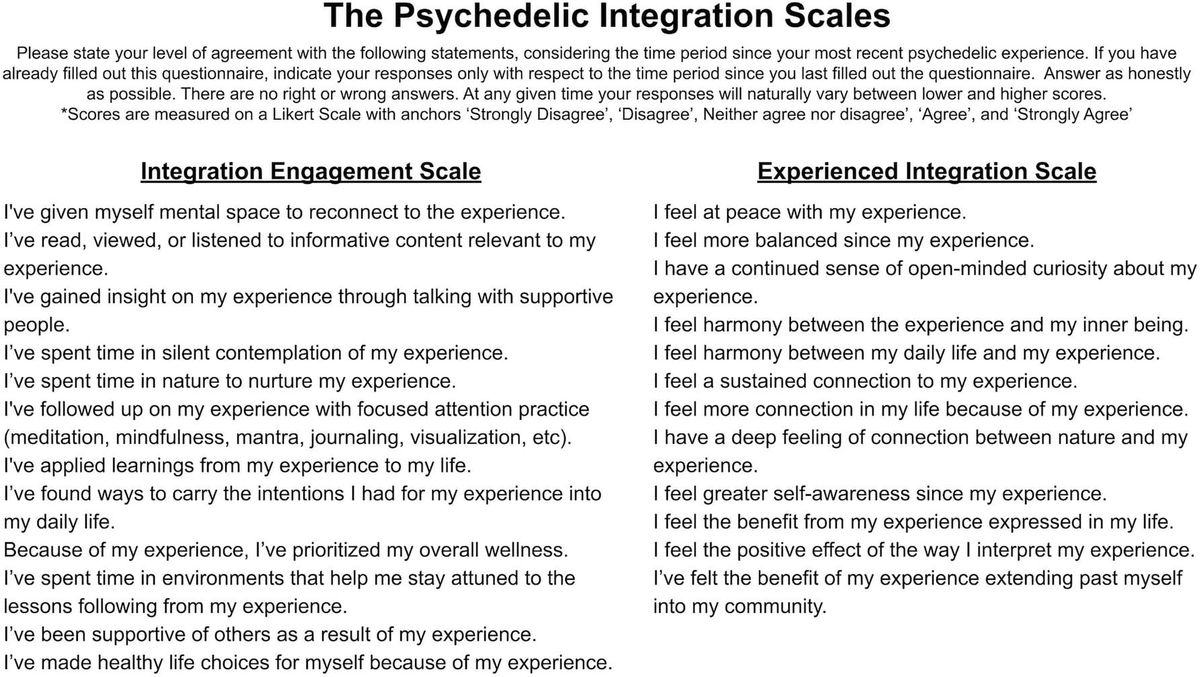
DASS-21 in a small ketamine therapy sample
During a period between 2022 and 2026, 18 people were given the DASS-21 where they rated their Depression, Anxiety and Stress before ketamine and after at least 1 ketamine journey. This analysis shows a breakdown by female-identifying to male-identifying, their scores, total change and overall whether they worsened, improved, or stayed the same on their total DASS 21 rating.
Client Outcome Clusters
Female-Identified (n=7)
Improved: 5 | Unchanged: 0 | Worsened: 2
Male-Identified (n=11)
Improved: 11 | Unchanged: 0 | Worsened: 0
Magnitude of Change Distribution (Total Cohort: n=18)
| ID | Initial (D / A / S) | Final (D / A / S) | Change | Progress |
|---|---|---|---|---|
| F #6 | 0 / 0 / 22 | 0 / 0 / 44 | +2 | Worsened |
| F #7 | 0 / 2 / 68 | 34 / 26 / 3090 | +82 | Worsened |
| F #8 | 18 / 12 / 2656 | 6 / 4 / 1222 | -34 | Improved |
| F #12 | 16 / 14 / 2252 | 2 / 6 / 1422 | -30 | Improved |
| F #14 | 2 / 2 / 812 | 0 / 0 / 22 | -10 | Improved |
| F #18 | 24 / 22 / 2874 | 2 / 4 / 1218 | -56 | Improved |
| F #22 | 24 / 18 / 2668 | 16 / 10 / 2248 | -48 | Improved |
| M #1 | 18 / 8 / 1844 | 8 / 4 / 820 | -24 | Improved |
| M #4 | 8 / 2 / 1222 | 2 / 4 / 1218 | -4 | Improved |
| M #8 | 16 / 12 / 1846 | 10 / 8 / 1230 | -16 | Improved |
| M #9 | 30 / 18 / 2270 | 0 / 0 / 44 | -66 | Improved |
| M #11 | 8 / 2 / 1424 | 2 / 0 / 1012 | -12 | Improved |
| M #12 | 8 / 2 / 1626 | 0 / 0 / 88 | -18 | Improved |
| M #13 | 38 / 28 / 38104 | 20 / 12 / 2456 | -48 | Improved |
| M #15 | 16 / 14 / 2252 | 2 / 2 / 1014 | -14 | Improved |
| M #16 | 12 / 6 / 2038 | 2 / 0 / 810 | -28 | Improved |
| M #19 | 2 / 2 / 1418 | 4 / 2 / 1016 | -2 | Improved |
| M #20 | 26 / 18 / 2872 | 14 / 10 / 2246 | -26 | Improved |
https://www.sciencedirect.com/science/article/pii/S0165032725006743
https://www.tandfonline.com/doi/full/10.1080/15305058.2025.2489359


 a
a
Self Actualization
Internal Family Systems (IFS) has a concept called "Self Energy" (which also includes creativity, although this was not included in the questionnaire).
Across 176 completed questionnaires gathered between 2021 and 2026, respondents described facets of IFS Self-energy experienced in the days following their ketamine therapy sessions. Because respondents could select multiple qualities per journey, percentages reflect the proportion of the 176 separate sessions in which each specific quality was endorsed.
Notably, Calm emerged as the most frequently endorsed post-treatment quality (76.1%), followed by Curiosity (52.8%) and Connectedness (51.7%), highlighting how ketamine therapy frequently supports grounded, open, and relational internal states during integration."
| Quality | Description | Questionnaires Marked () | Percentage |
|---|---|---|---|
| Calm | Remaining centered and grounded amidst internal chaos or external stressors | 134 | 76.1% |
| Curiosity | Open, non-judgmental desire to understand why parts feel or behave the way they do | 93 | 52.8% |
| Connectedness | Profound sense of harmony, understanding, and oneness with parts and the world | 91 | 51.7% |
| Clarity | Capacity to see situations and internal dynamics objectively, without fear distortion | 82 | 46.6% |
| Compassion | Deep, empathetic warmth toward your own parts and the struggles of others | 56 | 31.8% |
| Courage | Willingness to face painful memories, confront internal fears, and do vulnerable work | 36 | 20.5% |
| Confidence | Inner knowing and trust that you can handle difficult emotions and lead your system | 27 | 15.3% |
Creativity may be captured in other questionnaires. For example in the HRS, Q77. New thoughts or insights, journeys scored 3 or more in 62% of journeys. Also Q108. Experience of beauty scored 3 or more in 82% of journeys.
References
- Schwartz, R. C. (1995). Internal Family Systems Therapy. Guilford Press
 Michael DeMarco, PhD
 Michael DeMarco, PhD
 Michael DeMarco, PhD
 Michael DeMarco, PhD
 Michael DeMarco, PhD