
Spotlight: Ketamine, “Quantum Psychiatry”, Consciousness

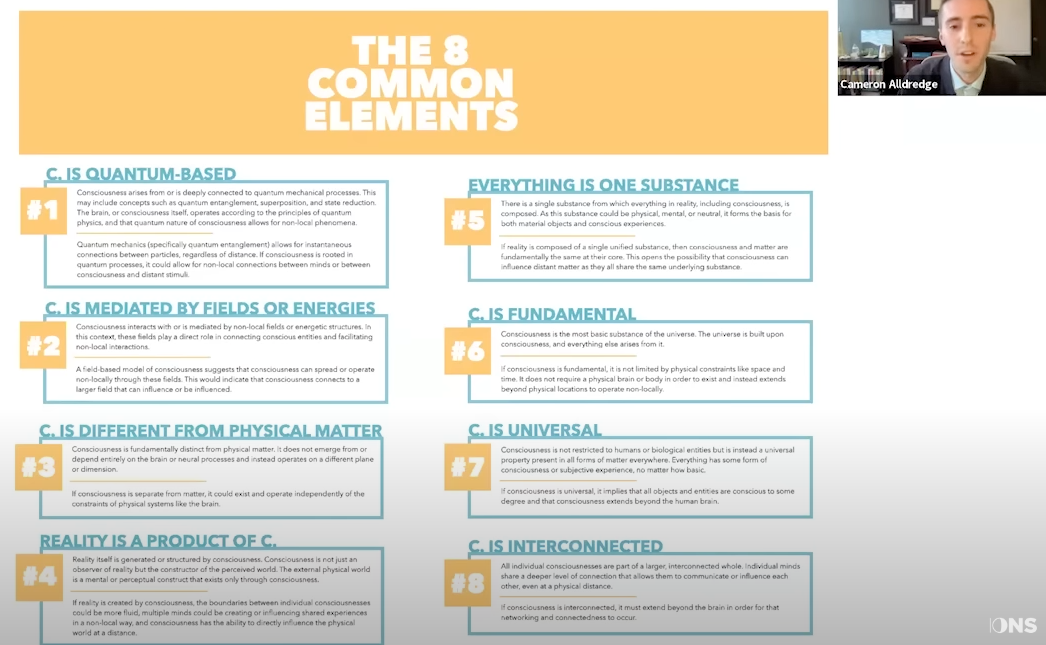
New 2026: From the journal Innovation in April 2026: Quantum evidence of nonlocal consciousness during clinical death (2026) "If consciousness can operate under quantum principles, then the boundaries between life, death, and cognition are far more permeable than current science allows... NDEs positively correlated with neuroplasticity during Cardiac Arrest. Biomarker models explained up to 56.8% of the variance in recall. These findings compel a radical rethinking of clinical death: consciousness may persist—quantum-bound, detectable, and not yet defeated.
Certain anesthetics and psychoactive agents, especially ketamine—a
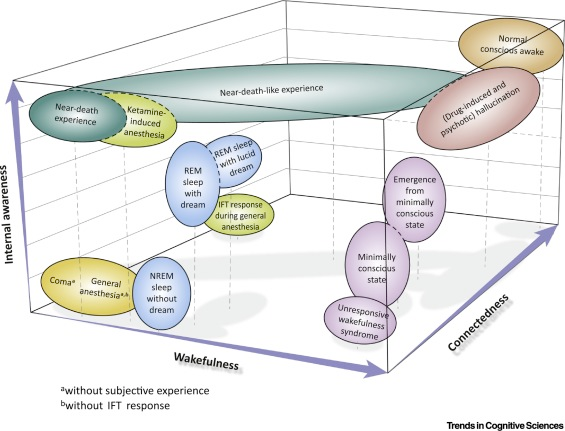
dissociative NMDA antagonist—are well-documented to induce phenomenological states that closely mimic spontaneous NDEs. These include out-of-body experiences, time distortion, depersonalization, and profound tranquility or transcendence.104–106 A large-scale semantic analysis of subjective reports has confirmed that ketamine-induced states are more similar to NDEs than those associated with serotonergic psychedelics.105 These similarities support the hypothesis that shared neurochemical mechanisms—such as transient NMDA receptor blockade and glutamatergic dysregulation under extreme stress—may underpin NDEs. One speculation is that the dying brain might endogenously release ketamine-like compounds or enter a disinhibited cortical state, temporarily supporting heightened internal awareness. These findings reintroduce anesthesiology into broader debates on the neural correlates of consciousness, including theories that embrace non-classical processes such as quantum brain dynamics. Notably, our study found correlations between verified quantum entanglement effects and conscious recall, lending empirical support to theoretical models—such as the Hameroff and Penrose (2014) theory 57—that attempt to explain how awareness might emerge under otherwise suppressive conditions."
 Stacey Schmeidel, Wellesley College
(2024): "By demonstrating that drugs affecting microtubules within neurons delay the onset of unconsciousness caused by anesthetic gases, the study supports the quantum model over traditional classical physics theories. This quantum perspective could revolutionize our understanding of consciousness and its broader implications, potentially impacting the treatment of mental illnesses and our understanding of human connection to the universe."
 Dr. K.L.R. Jansen
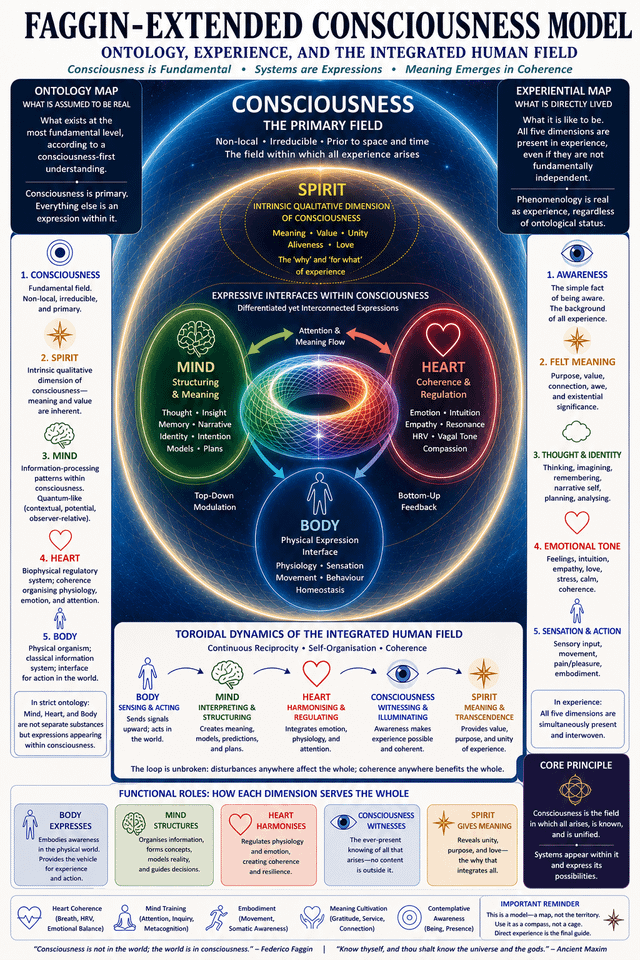
Karl Jansen on ketamine in (1999): "to improve our understanding of psychedelic experience we may need to reconsider some of the material which has been dismissed as hallucinations, psychosis, suggestibility, stupidity and fraud. Hallucination is only another descriptive term - it doesn't really explain anything. 'Quantum' based explanations for certain mental states have started to appear, and we should be wary of dismissing these new theories out of hand."
By transiently blocking NMDA receptors, particularly on inhibitory interneurons, KT induces a surge in glutamatergic neurotransmission and consequent AMPA receptor stimulation, thereby activating downstream signaling cascades, including brain-derived neurotrophic factor release and mammalian target of rapamycin pathway activation (Zanos and Gould, 2018; Matveychuk et al., 2020). These changes facilitate synaptic plasticity and synaptogenesis, mechanisms hypothesized to underlie KT's rapid antidepressant efficacy (Krystal et al., 2024). Clinically, numerous trials have confirmed KT's remarkable therapeutic potency in TRD, with significantly higher response rates than placebo observed as early as 24 h post-infusion (Singh et al., 2016; Phillips et al., 2019; McIntyre et al., 2021). To address KT's transient efficacy, which typically peaks within a week, repeated-dose strategies and related derivatives, such as intranasal esketamine (approved by the FDA in 2019 for TRD), have been developed, reflecting a broader acceptance of glutamate-based interventions in psychiatric practice (Krystal et al., 2024). Consequently, KT has become a prototypical agent representing a new paradigm in antidepressant therapy, bridging fundamental neuroscience with promising clinical outcomes.
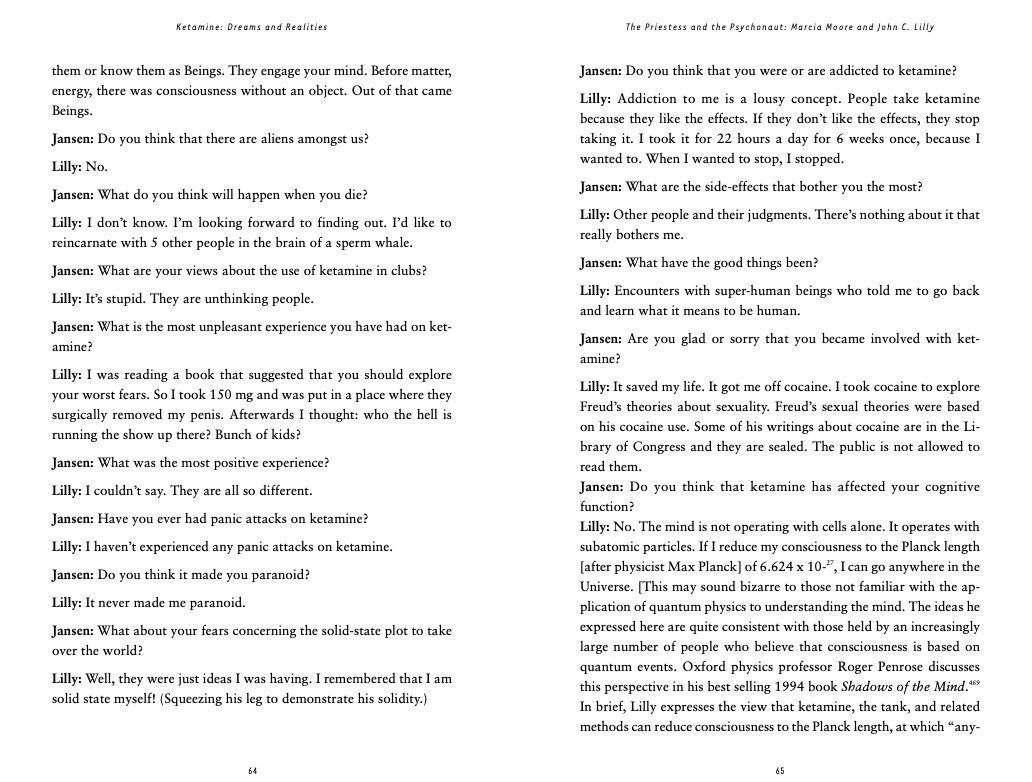
Pair with Jansen's book "Ketamine Dreams & Realities", in which he interviews the brilliant John C. Lilly.
 Michael DeMarco, PhD
 Kaushik Naskar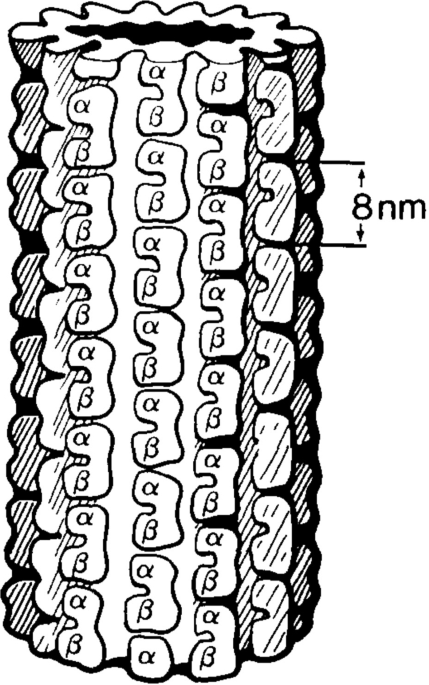
(2024): "Not all activities in living creatures can be explained by classical dynamics. The application of quantum physics in biology helps to study the unexplained phenomena in cells. More detailed research work is needed rather than rejecting the concept of the intervention of quantum physics in biology."
 Madeline Frank
"Propofol, ketamine, and etomidate reduce the distances that Kinesin-1 KIF5 and Kinesin-2 KIF3 travel along microtubules in vitro." (2022)
What if the molecular machines that read and write your DNA are quantum? (Goel, Busstra, 2025)"Busstra, Goel talk about experiment and explore the new theoretical framework it could lead to: a new physics to understand life, living systems and consciousness."
Michael DeMarco, PhDXun Ma and Aoping Wang
(2026):"The riddle of consciousness remains profoundly complex: quantum mechanics may be one piece of the puzzle, but a solution will likely require sustained multidisciplinary collaboration. In the explorations ahead, progress should be guided by the scientific method, advancing with a balance of curiosity and skepticism."
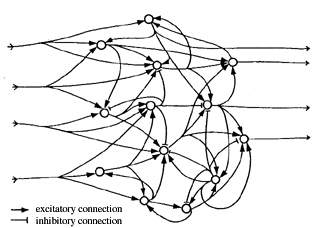
(2013) Comparison of the effects of acute and chronic administration of ketamine on hippocampal oscillations. Relevance for the NMDA receptor hypofunction model of schizophrenia
A great breakdown on how ketamine affects oscillations affecting consciousness.
Chacruna Institute Michael DeMarco, PhD
 Michael DeMarco, PhD