
Psychedelic Research a 6 Year Review & Practice
 Michael DeMarco, PhD
 Michael DeMarco, PhD
 Michael DeMarco, PhD
 Michael DeMarco, PhD
Therapeutic ketamine research has continued non-stop since 1962, and has been safely administered to billions of people around the world since it was approved by the FDA in 1970 for use in humans and animals.
 Michael DeMarco, PhD
 Michael DeMarco, PhD
 Michael DeMarco, PhD
 Michael DeMarco, PhD
 Michael DeMarco, PhD
 Michael DeMarco, PhD
curated by hand since 2020,
by Michael DeMarco, PhD, human
"I scour the literature on psychedelic medicines, especially in their application to human mental health and well-being, including pain management as a harm reduction and professional development institute project. My goal is to offer an independent and comprehensive look at what over 100 years of research has to say about the experiences of different molecules we have labeled "psychedelic" on humans in our bodies, minds, hearts and psyches. See some of my own addition to the literature in Psychedelics in Palliative Care (Glass, ed, 2025). As a psychedelic mental health practitioner, I want policy makers, providers, and the public to be aware of just how much research exists, and what it says, unfiltered by an algorithm.
Propagandists may point to poorly-cited outlier papers, drawing sensational conclusions, but psychedelic research continues around the world, and there is robust, comprehensive study on the experience of these medicines in humans and animals."
 Michael DeMarco, PhD
a few of the works cited...
Preliminary evidence demonstrates that Ketamine-Assisted Psychotherapy (KAP) can significantly improve depression, demoralization and existential distress in seriously ill people. We will discuss: 1. the history and science of psychedelics; 2. ketamine pharmacology, and KAP indications and delivery models; 3. putative KAP mechanisms of action; and 4. examples of KAP program development, including making the case, potential obstacles, and creative solutions.
Ketamine in Bipolar Disorder: A Review (Wilkowska, et al, 2020)
Relatively few pharmacologic agents are proven safe and effective in adults with TRD. NNT estimates for investigational psilocybin and esketamine in TRD indicate clinical meaningfulness. The NNH profile for both aforementioned agents is clinically acceptable. Our results underscore the clinical relevance of these treatment options in adults with TRD.
A low number to treat and a high number to harm suggests efficacy and safety of racemic ketamine and esketamine across thousands of clients. It takes not very many ketamine treatments to help, and a large number of treatments to statiscally help and harm, also indicating a range of safe repeated dosing.
Deep posteromedial cortical rhythm in dissociation (2020)
Dissociation in human beings is a self-reported state of mind, and no experimental technique in rodents or in humans can currently define this subjective experience in full. However, the clinically guided paradigm reported here could provide a framework of behavioural, optical and physiological tools to enable exploration of the neural activity that underlies dissociative states (Vesuna, et al, 2019).
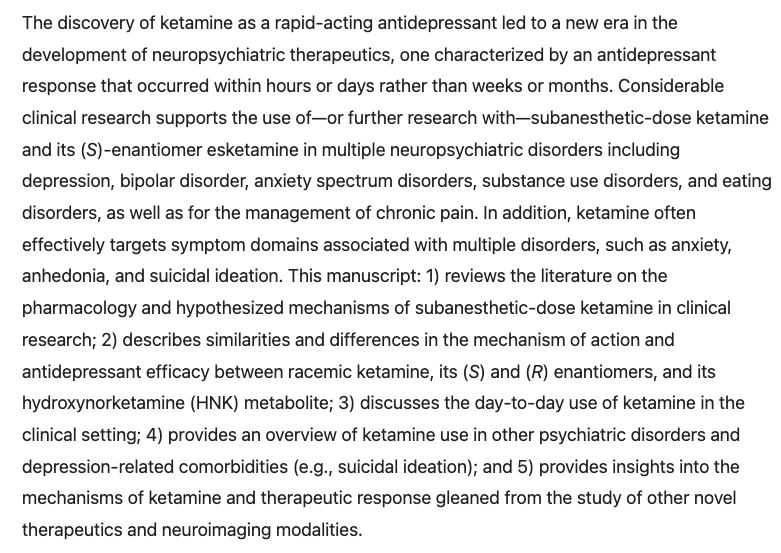
Ketamine in neuropsychiatric disorders: an update (Johnston, et al, 2023)
Considerable clinical research supports the use of—or further research with—subanesthetic-dose ketamine and its (S)-enantiomer esketamine in multiple neuropsychiatric disorders including depression, bipolar disorder, anxiety spectrum disorders, substance use disorders, and eating disorders, as well as for the management of chronic pain.
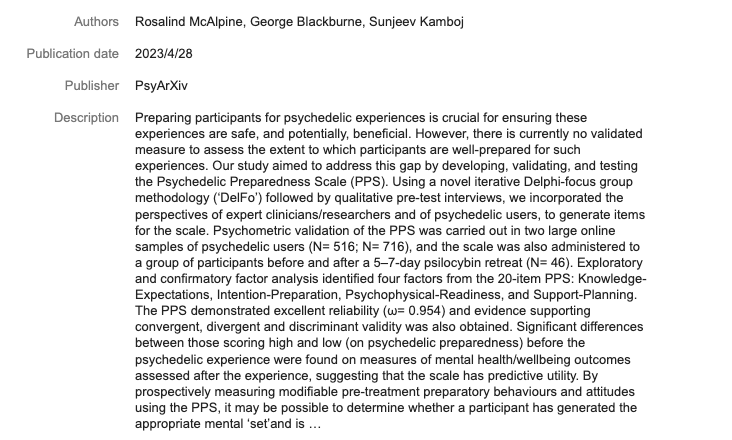
Development and psychometric validation of a novel scale for measuring ‘psychedelic preparedness’
Significant differences between those scoring high and low (on psychedelic preparedness) before the psychedelic experience were found on measures of mental health/wellbeing outcomes assessed after the experience, suggesting that the scale has predictive utility.
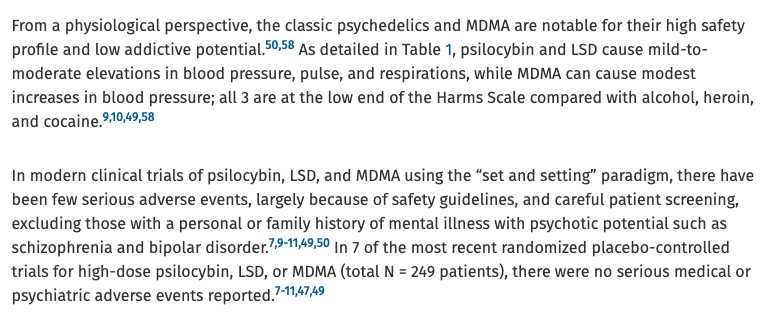
While the neural underpinnings remain to be clarified, the psychedelic-induced state seems to allow one to recollect and process deep autobiographical information, achieve new understandings of one's self and relationships with others, and gain greater appreciation of one's place within the cosmos.5,61,62 This state is closely linked to the concept of “mystical experience” which in multiple studies with classic psychedelics predicts therapeutic efficacy.9,11,45,47,55 “Ego dissolution” is another term used to describe a loss of the usual sense of self as separate entity.13 The quality and degree of psychedelic-induced ego dissolution and mystical experience are typically measured in clinical trials with validated psychometric instruments such as the 5-Dimensional Altered States of Consciousness Questionnaire and the Mystical Experience Questionnaire.9,11,45,47,49,55,61
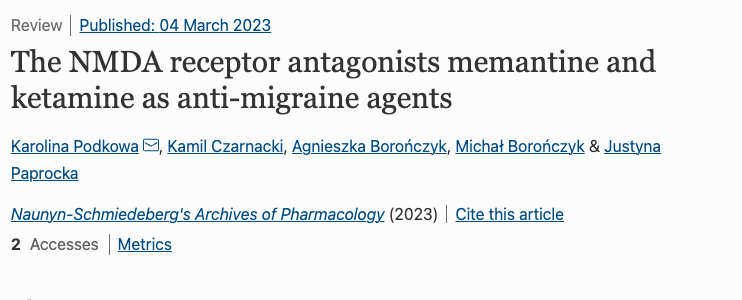
The NMDA receptor antagonists memantine and ketamine as anti-migraine agents (Podkawa, et al, 2023)
Migraine is a debilitating disorder affecting females more frequently than males. There is some evidence that drugs targeting glutamate receptors: memantine and ketamine might be beneficial in the therapy of this entity. Therefore, the purpose of this work is to present NMDA receptor antagonists, memantine and ketamine, as potential anti-migraine agents.
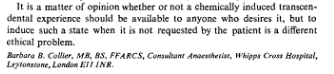
Ketamine and the conscious mind (1972)
It is a matter of opinion whether or not a chemically induced transcendental experience should be available to anyone who desires it, but to induce such a state when it is not requested by the patient is a different ethical problem.
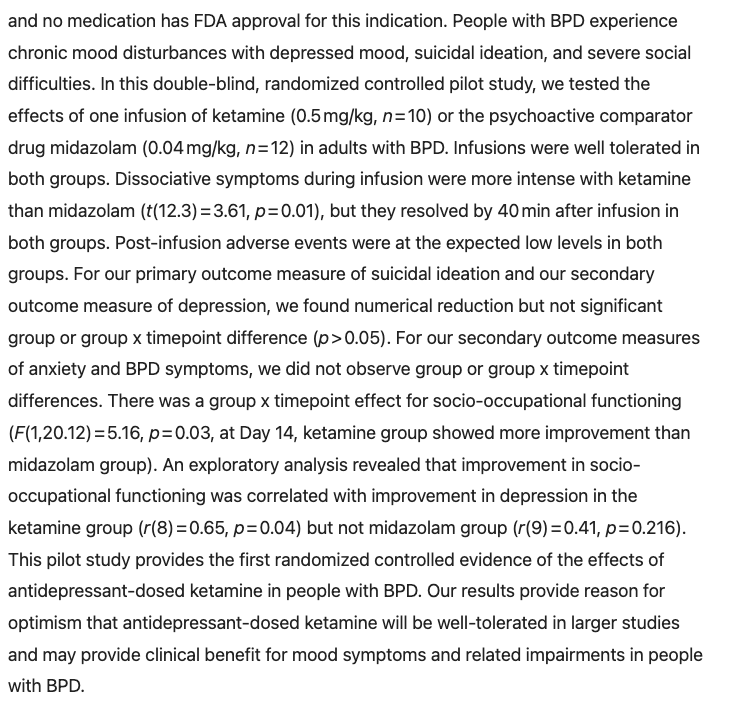
A pilot randomized controlled trial of ketamine in Borderline Personality Disorder (2023)
Infusions were well tolerated in both groups. Dissociative symptoms during infusion were more intense with ketamine than midazolam (t(12.3) = 3.61, p = 0.01), but they resolved by 40 min after infusion in both groups. Post-infusion adverse events were at the expected low levels in both groups.
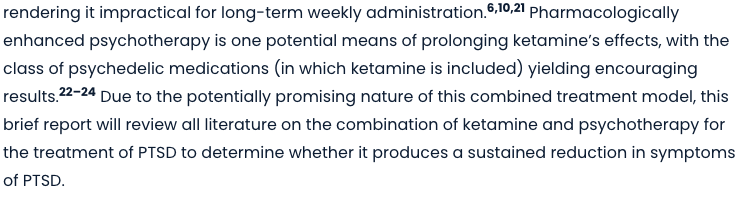
Pharmacologically enhanced psychotherapy is one potential means of prolonging ketamine’s effects, with the class of psychedelic medications (in which ketamine is included) yielding encouraging results