
Telehealth
 Michael DeMarco, PhD
Telehealth: A Review of the Literature
Telehealth, or working remotely with a mental health provider, has been studied for decades, and more recently has shown to be a useful support in ketamine-assisted psychotherapy
Ketamine was FDA approved for use in humans and animals in 1970, and labeled a "dissociative anesthetic" to avoid being associated with "classical psychedelics" of the 1960's. Ketamine has been administered at very high doses to billions of humans and animals since it was synthesized in 1962. Ketamine has been prescribed off-label for decades by medical clinicians who specialize in this medicine’s sub-anesthetic doses for mental health and pain management, and more recently in collaboration with practitioners specializing in psychedelic therapy preparation, support and integration.
Your independent medical provider may prescribe therapeutic ketamine in some route of administration as a standalone treatment. Knowledgeable medical providers will refer you to some sort of human support to prepare you for this experience, support you while you work with ketamine, and help you apply its benefits into your ongoing mental health practice. A psychedelic mental health practitioner may be a therapist or mental health coach, psychedelic guide or facilitator, psychedelic chaplain, death doula, nurse, shaman, or other type of practitioner of the body, mind, heart, and spirit. Psychedelic practitioners support the experience of working with ketamine, as well as integrating the positive benefits of the medicine into your ongoing experience of being a human.
Learning to integrate psychedelic experiences for improved mental health and well-being in daily life is how psychedelic- therapy brings these transformative substances and experiences to the wider population- by incorporating a bio-psycho-social-spiritual approach.
See your medical provider before working with any psychedelic medicine. Ketamine is available only by prescription.
Humans support this work.
Routines keep you alive, until they turn into ruts. Rituals of introspection and inward journeying may lead towards transformation, especially when paired with informed care and community support.
Approaching this medicine work with careful intention, screening, medical clearance, and multi-modal support is how we strive to maximize this medicine’s benefits for as many people as possible who’ve yet to find relief with other medicine practices, treatments, or approaches.
Finding the minimal amount of medicine and dose needed for the most amount of improved quality of life is key.
The medical provider will decide the route of administration and setting — whether in an office being monitored, or at home with a sober sitter of your choice.
A psychedelic practitioner specialist is available in person, in office, clinic, and/or via telehealth to prepare, support and help you integrate your newfound perspectives into an ongoing mental health and wellness practice. Mental health practitioners have offered telehealth by phone and then online for decades.
Research on cognitive behavioral therapy and other mental health via telehealth spans over 20 years, as well as other mental health interventions delivered remotely.
Preparation and integration provided via telehealth, in-home, in office, hospice, nature, or wherever is most convenient for you.
 Eve-Lynn Nelson
(2003) Telemedicine increases access to psychological interventions by linking the child and the clinician using videoconferencing (VC). The current study evaluated an 8-week, cognitive-behavioral therapy (CBT) intervention for childhood depression either face-to-face (F2F) or over VC. The CBT treatment across the two conditions was effective. The overall response rate based on post-evaluation with the K-SADS-P was 82%. For the CDI total score, both the Time and the Group by Time effects were significant (p < 0.05). The interaction effect reflected a faster rate of decline in the CDI total score for the VC group.
 Stéphane Bouchard
(2004)- Results showed that CBT delivered by videoconference was as effective as CBT delivered face-to-face. There was a statistically significant reduction in all measures, and the number of panic-free participants among those receiving CBT by videoconference was 81% at post-treatment and 91% at the 6-month follow-up. None of the comparisons with face-to-face psychotherapy suggested that CBT delivered by videoconference was less effective. These results were confirmed by analyses of effect size. The participants reported the development of an excellent therapeutic alliance in videoconference as early as the first therapy session.
 Lucille Griffiths
(2006) "First, each case manager was instructed in the use of telemedicine for clinical consultation, and given training in CBT. This was done via videoconference. Then the clients were introduced to telemedicine. Following six to eight intensive weekly sessions of CBT, there was improvement in certain clinical outcome measures (i.e. the Mental Health Inventory and the Health of the Nation Outcome Scale). There was a significant improvement (P<0.05 using a t-test) in the client Mental Health Inventory scores before (mean = 109) and after treatment (mean = 148)."
 Psychiatric News Alert
from JAMA 2025
 Michael DeMarco, PhD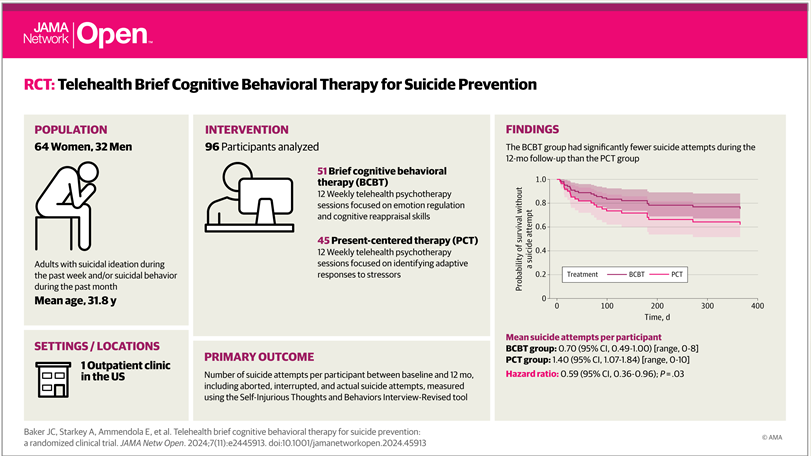
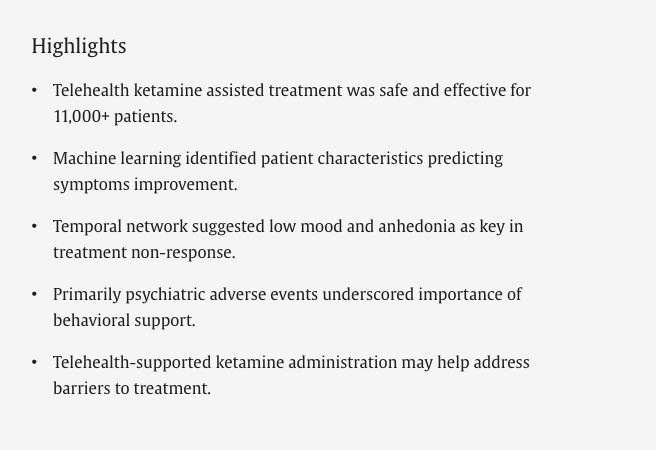
At-home, telehealth-supported ketamine treatment for depression: Findings from longitudinal, machine learning and symptom network analysis of real-world data (Mathai, et al, 2024)
 PlanetMedicines
 SCIENMAG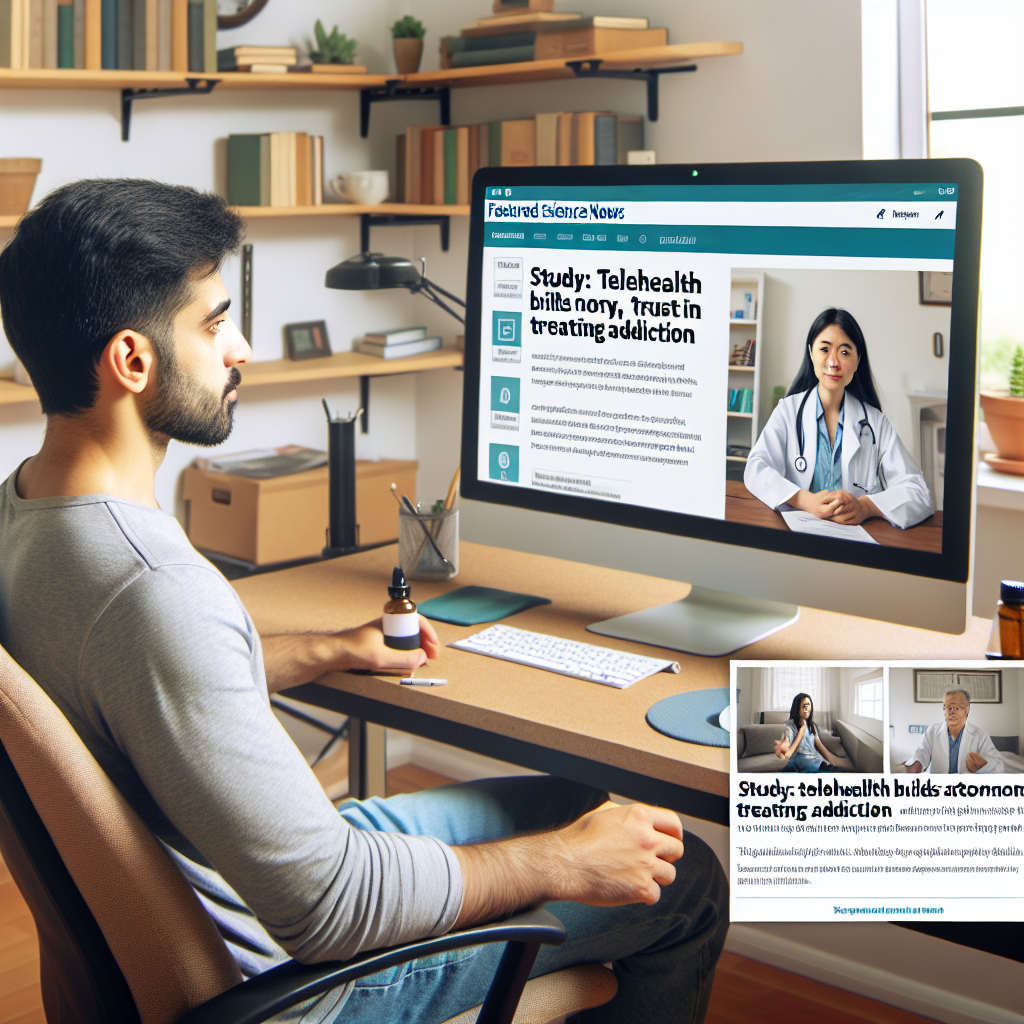
 [email protected]
Digital Tech Moves Depression Management Beyond Telemedicine
 Authors Info & Affiliations
 Nyssa Z. Bulkes
"Results suggest telehealth as a viable care alternative with no significant differences between in-person and telehealth groups in depressive symptom reduction, and significant increases in self-reported quality of life across both groups."
 CARRIE MACMILLAN
 Zara Abrams
 American Medical Association

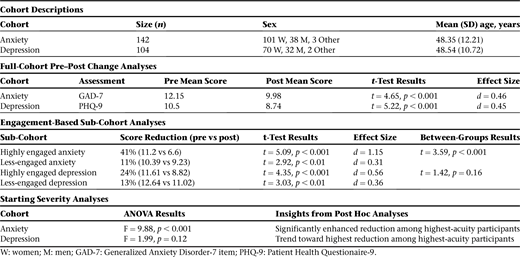
Digital CBT Interventions Predict Robust Improvements in Anxiety and Depression Symptoms: A Retrospective Database Study (Holley, et al, 2024)
 Michael DeMarco, PhD
 Kimberly Bloom-Feshbach
2025: A hybrid consultation model allows hospitalists and psychiatrists to collaboratively care for BHC inpatients with professionally and personally rewarding work.
 Michael DeMarco, PhD
 Michael DeMarco, PhD
(2025): "Technology-enabled coaching, as part of a blended care platform, improved depression, anxiety, and transdiagnostic emotional processes. Participants with higher baseline depression and anxiety reported greater improvements, highlighting coaching’s effectiveness for people with elevated needs."
 Psychedelic Mental Health
At-Home Telehealth-Supported Subcutaneous Ketamine Therapy for Safety, Feasibility, and Clinical Outcomes in Adults With Moderate to Severe Depression, Anxiety, or Posttraumatic Stress Disorder in a Large, Heterogeneous Cohort in the United States: Retrospective Cohort Study (2026) Results suggest that at-home subcutaneous ketamine is a safe, feasible intervention associated with high rates of symptom reduction in depression, anxiety, and PTSD https://www.jmir.org/2026/1/e92647
 Michael DeMarco, PhD
"This pilot program offers virtual, one-on-one support to patients and may be one of the first instances of a major hospital providing ketamine integration modeled on spiritual care."
 Åse Lundin
(2026): Chronic pain is a growing global public health challenge and the leading cause of years lived with disability. It significantly impacts various aspects of daily life, including participation in working life, resulting in increased sick leave and substantial burdens at both the personal and societal levels. Person-centered care (PCC) is a practiced ethic that recognizes the patient as a partner in care. Partnership is established through incorporating the person's narrative, shared decision-making, and documentation of jointly agreed goals. Remotely delivered PCC interventions have been shown in other studies to improve self-efficacy and facilitate return to work among persons on sick leave."
 Elizabeth Coe
(2026): "This study shows how the first 31 people (23 Veterans, eight family members) reacted to receiving free mental health therapy from a new telehealth clinic in Texas, United States. They said they felt better about their symptoms and their quality of life after receiving telehealth therapy. They also said they were satisfied with the videoconferencing technology and enjoyed working with their therapists. This shows that telehealth could be a good way of helping Veterans and their families with their mental health, especially if they do not have connections to other types of help."
 Ahmet Buğa
(2026): Overall, while online psychological counseling offers substantial opportunities, its effectiveness depends on individualized approaches, strong technological infrastructure, and clear ethical guidelines."