
2. ABC Model
The ABC exercise is used in several different forms of cognitive behavioral therapy as a way to activate the prefrontal cortex.Irrational beliefs are rigid underscoring mental illness, such as with depression and anxiety, whereas rational beliefs are more flexible and linked to mental health. Therapy assertively attempts to shift irrational beliefs to rational ones. Emotion regulation and adaptability are robustly advanced, and certainly the latter as irrational beliefs reduce the capacity to adapt to ever changing circumstances.
A- Activating Event/Adversity What's going on? What triggered you? What happened?
B- What sort of thoughts are going through your mind about this triggering event? Why do you think this happened? Do you have any if only thinking about this thing that happened?
Once you have had a chance to contemplate what you're thinking about this situation, you might be able to find some of the types of thoughts you have.
Investigating & Identifying Beliefs
- All-or-Nothing Thinking: Seeing people or events in absolute (black-or-white) terms, without recognizing the middle ground (e.g., success/failure; perfect/worthless)
- Blaming: Blaming yourself or others too much. Focusing on who is to blame for problems rather than what you can do about them.
- Catastrophizing: Blowing things out of proportion, telling yourself that you won't be able to handle something, or viewing tough situations as if they will never end.
- Downplaying Positives: Minimizing or dismissing positive qualities, achievements, or behaviors by telling yourself that they are unimportant or do not count.
- Emotional Reasoning: Believing something is true because it feels true. Relying too much on your feelings to guide decisions.
- Fortune Telling: Making negative predictions about the future, such as how people will behave or how events will play out.
- Intolerance of Uncertainty: struggling to accept or tolerate things being uncertain or unknown (e.g., repeatedly wondering "what if?" something bad happens).
- Labeling: describing yourself or others using global, negative labels (e.g., making judgments about one's character or name calling)
- Mind Reading: Jumping to conclusions about another persons thoughts, feelings, or intentions without checking them out.Overgeneralizing: Drawing sweeping conclusions on the basis of a single incident, such as when we say people or things are "always" or "never" a certain way.
- Personalizing: Telling yourself that events relate to you and they may not.
- Just World: Good things happen to good people. Bad things happen to bad people.
- "Shoulding" and "Must" Statements: and how things or people "should" or "must" be. Treating your own standards or preferences as rules that everyone must live by.
Thoughts and feelings about this situation are like waves--they come, are here for a short while, and then they are gone. Remind yourself that no thought or feeling is permanent. You have never felt a feeling forever, and you have never had a thought in your head 100% of the time all the way through your life. They are all just temporary experiences. Try to accept that you have troubling thoughts and feelings sometimes. Try to treat them as visitors that come for a little while and then leave. Make an effort to not judge yourself or anyone else for having them, viewing them as a natural part of living. All humans experience them; it is normal and healthy.
Thoughts that lead to feelings that don't resolve on their own may indicate Stuck Points.
- If I had done my job better, then other people would have survived.
2. Because I did not tell anyone, I am to blame for the abuse.
3. Because I did not fight against my attacker, the abuse is my fault.
4. I should have known he would hurt me.
5. It is my fault the accident happened.
6. If I had been paying attention, no one would have died.
7. If I hadn’t been drinking, it would not have happened.
8. I don’t deserve to live when other people lost their lives.
9. If I let other people get close to me, I’ll get hurt again.
10. Expressing any emotion means I will lose control of myself.
11. I must be on guard at all times.
12. I should be able to protect others.
13. I must control everything that happens to me.
14. Mistakes are intolerable and cause serious harm or death.
15. No civilians can understand me.
16. If I let myself think about what has happened, I will never get it out of my mind.
17. I must respond to all threats with force.
18. I can never really be a good, moral person again because of the things that I have done.
19. Other people should not be trusted.
20. Other people should not trust me.
21. If I have a happy life, I will be dishonoring my friends.
22. I have no control over my future.
23. The government cannot be trusted.
24. People in authority always abuse their power.
25. I am damaged forever because of the rape.
26. I am unlovable because of [the trauma].
27. I am worthless because I couldn’t control what happened.
28. I deserve to have bad things happen to me.
29. I am dirty.
30. I deserved to have been abused.
31. Only people who were there can understand.
32. If I don't explain everything in detail, then you won't understand (or believe me).
Core beliefs sometimes sound odd when we say them out loud, but in the moments that we feel the worst they seem very true to us.
I am bad.
I am unlovable.
I am worthless, inadequate, or not good enough.
The world is a dangerous place.
People are bad, untrustworthy, selfish, or dangerous.
Life is bad or unfair.
C- Consequence/s
Emotional Consequence - How did you end up feeling as a result?
Behavioral Consequence- What did you do when you were feeling these emotions?
Somatic Consequence- How did that feel in your body?
G: Goals- What's the worst I'd like to feel? Is my thinking at B getting me closer to my goal, or further away?
D: Directions, Dispute, Debate: For example, examining the evidence– What proof?
E. Experimenting with a new Effect


15 minutes of daily practice is all you need
Michael Hickey
"Within Existential Therapy, clinicians work with their clients to accept responsibility for their lives, which is something that REBT therapists do as well. Taking ownership of one’s thoughts, emotions and behaviors is first required in REBT, before any challenging or replacing of irrational beliefs can occur."
 Dan Pilat
Smart Recovery is a recovery model based on Rational Emotive Behavior Therapy
How CBT Dismantles ADHD Negativity: Cognitive Behavioral Therapy Overview
CBT is supported by clinical results and research evidence showing that the therapy delivers real-world benefits for adults with ADHD— namely higher self-esteem, productivity, and happiness. Learn more about ‘cognitive distortions’ and how to unravel them with cognitive behavioral therapy.
Using CBT to Empower Black Patients (2025)
CBT's cultural adaptations can empower Black patients by addressing internalized racism and negative core beliefs, enhancing therapy outcomes.
Clinicians should use culturally sensitive strategies, like Socratic questioning and validation, to build strong therapeutic relationships with Black patients.
Expanding treatment to include racial empowerment and pride is crucial for mitigating the psychological effects of racism and fostering well-being.
Techniques like bibliotherapy can enhance critical consciousness, promote social action, and strengthen racial pride, contributing to overall psychological resilience.

AFFIRM Youth is an eight-session, manualized affirmative cognitive-behavioral group intervention. It is designed to reduce depression and improve coping skills and self-efficacy for LGBTQ+ youth. Using a trauma-informed approach, AFFIRM Youth is tailored to the experiences of LGBTQ+ youth and provides them opportunities to develop identity cognition (e.g., self-awareness, identifying risk), mood (e.g., recognizing the link between thoughts and feelings), and behavior (e.g., identifying strengths and ways of coping), as well as equipping them with the tools to self-manage their mental health.

We have created and evaluated among the first LGBTQ-affirming psychotherapy programs with empirical evidence for improving LGBTQ people’s mental health. These treatments are developed in close consultation with community members and clinical experts and show associations with reduced depression, anxiety, substance use across several clinical trials. Most prominently, with $13M in NIH funding, we have developed and evaluated LGBTQ-affirmative CBT with gay and bisexual men, queer women, and transgender and non-binary individuals in clinical trials, community settings, and countries throughout the world. The treatment has been successfully delivered in-person, remotely, in groups, and online. Our LGBTQ-affirmative CBT program is considered a “treatment that works” and is cited in LGBTQ practice guidelines of the American Psychological Association.
Michael DeMarco, PhD
Rational-emotive therapy (Bowins, 2021)
Albert Ellis started this form of therapy in the 1950’s, basing it on the notion that emotional reactions to stimuli are mediated by cognitions: A—Activating Event, B—Beliefs, C—Consequence (ABC model). A to B to C, not A to C. Irrational beliefs are rigid underscoring mental illness, such as with depression and anxiety, whereas rational beliefs are more flexible and linked to mental health. Therapy assertively attempts to shift irrational beliefs to rational ones. Emotion regulation and adaptability are robustly advanced, and certainly the latter as irrational beliefs reduce the capacity to adapt to ever changing circumstances.
Skip to content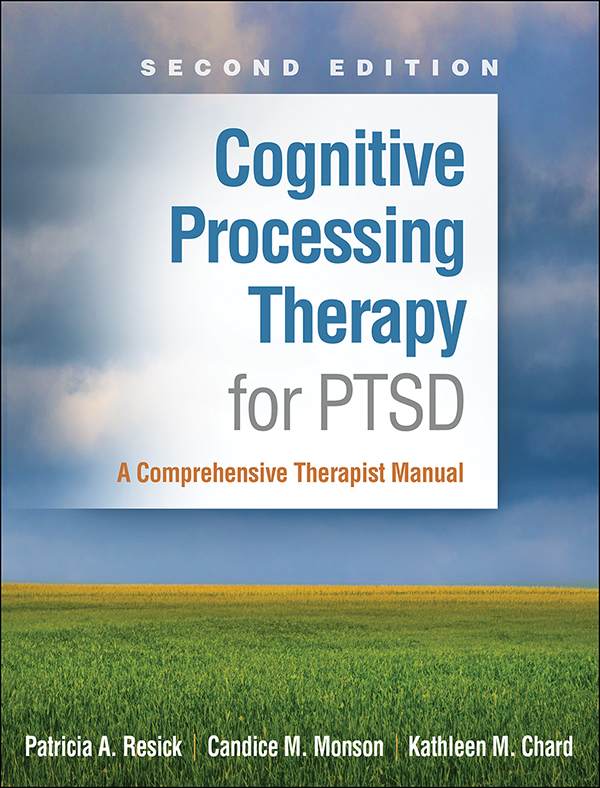
Cognitive Processing Therapy (CPT) is a cognitive-behavioral therapy (treatment that focuses on thoughts and feelings) for Posttraumatic Stress Disorder, or PTSD, and related conditions. PTSD can develop when an individual experiences a traumatic event such as physical and sexual abuse or assault, accidents, threats, military combat, or being a witness to violence or death. CPT focuses on the connections between thoughts, feelings, behavior and bodily sensations. CPT is an evidenced based therapy which means that it has been proven to be effective through rigorous scientific research. CPT provides a way to understand why recovery from traumatic events is difficult and how symptoms of PTSD affect daily life. The focus is on identifying how traumatic experiences change thoughts and beliefs, and how thoughts influence current feelings and behaviors. An important part of the treatment is addressing ways of thinking that might keep individuals “stuck” and get in the way of recovery from symptoms of PTSD and other problems.