
5. Identifying & Investigating
 Donald J. Robertson
"Stoicism provides the clearest example of a system of psychotherapy in ancient Greek or Roman philosophy. Albert Ellis acknowledged that some of the central principles of Rational Emotive Behaviour Therapy were “originally discovered and stated” by the Stoics and Beck that “the philosophical origins of cognitive therapy can be traced back to the Stoic philosophers...This article highlights Stoicism’s similarities to modern mindfulness and acceptance-based CBT and its potential as an approach to building emotional resilience."
Cognitive Processing Therapy (CPT) is cognitive behavioral therapy for trauma. In CPT, patients learn to identify problematic beliefs, termed “stuck points,” that drive their distress and negatively impact their ability to function. Through dialogue between a clinician and patient, as well as the use of structured worksheets, patients are taught the necessary skills to identify stuck points and develop alternative ways of thinking about themselves, others, and the world.
Stuck points are thoughts that keep us from recovering. Stuck points are concise statements that reflect a thought – not a feeling, behavior, or event. Other forms of CBT call these irrational beliefs, self-defeating beliefs, or cognitive distortions.
From Cognitive Processing Therapy for PTSD: A Comprehensive Therapist Manual, Second Edition, by Patricia A. Resick, Candice M. Monson, and Kathleen M. Chard. Copyright © 2024 The Guilford Press.
Examples of Stuck Points
1. If I had done my job better, then other people would have survived.
2. Because I did not tell anyone, I am to blame for the abuse.
3. Because I did not fight against my attacker, the abuse is my fault.
4. I should have known he would hurt me.
5. It is my fault the accident happened.
6. If I had been paying attention, no one would have died.
7. If I hadn’t been drinking, it would not have happened.
8. I don’t deserve to live when other people lost their lives.
9. If I let other people get close to me, I’ll get hurt again.
10. Expressing any emotion means I will lose control of myself.
11. I must be on guard at all times.
12. I should be able to protect others.
13. I must control everything that happens to me.
14. Mistakes are intolerable and cause serious harm or death.
15. No civilians can understand me.
16. If I let myself think about what has happened, I will never get it out of my mind.
17. I must respond to all threats with force.
18. I can never really be a good, moral person again because of the things that I have done.
19. Other people should not be trusted.
20. Other people should not trust me.
21. If I have a happy life, I will be dishonoring my friends.
22. I have no control over my future.
23. The government cannot be trusted.
24. People in authority always abuse their power.
25. I am damaged forever because of the rape.
26. I am unlovable because of [the trauma].
27. I am worthless because I couldn’t control what happened.
28. I deserve to have bad things happen to me.
29. I am dirty.
30. I deserved to have been abused.
31. Only people who were there can understand.
- If I don't explain everything in detail, then you won't understand (or believe me).
What does it mean to hold on to this belief? WHat does it mean about your Self? Others? The world you live in? What does holding on to this belief do for you?
 Steven C. Hayes, PhD
Our ability to step back from our thoughts grows stronger as we practice. When we learn defusion skills, we can take the energy of our counterproductive yearning and pivot it toward learning to be gently guided by our experiences.
Acceptance and Commitment Therapy (ACT) teaches a concept of cognitive defusion- "I’m having the thought that…” creates psychological distance, greater perspective, and emotional regulation. In REBT this is called metacognititon or thinking about our thinking.
Defusion: How to Detangle from Thoughts & Feelings
YOU are not your THOUGHTS
 Ashley Carucci
 Jennifer Caspari Ph.D.
Thoughts are merely sounds, words, stories, and bits of language passing through our minds.Thoughts may or may not be true. We don’t automatically believe them.Thoughts may or may not be important. We pay attention only if they’re helpful.Thoughts are not orders. We don’t have to obey them.Thoughts may or may not be wise. We don’t automatically follow their advice.


"take steps on your own to help break the cycle of rumination.1, 2, 4... Distract yourself with activities that will interrupt the negative thinking and focus on more positive memories.Try to deliberately recall times when things worked out even with challenges. Enlist the help of family or friends in remembering past positive experiences, times when things turned out well. This can help shift your thinking down a different path. Physical activity and change in environment, especially to a place that has positive associations for you, can help too. Try to separate out different problems or break down larger problems into smaller parts. Tackle one issue at a time. Make a step-by-step plan, be as specific as possible. Write it down. Then begin to move forward, taking action one step at a time.
Bryan E. Robinson Ph.D.
What if I'm triggered?

"Research on unconditional self-acceptance found that a low level of unconditional self-acceptance correlates with depression, anxiety, anger, and neuroticism (Popov, 2019; Prihadi et al., 2019; Andronikos, 2021). High levels of unconditional self-acceptance were in general strongly related to mental health, happiness, self-esteem, life satisfaction, well-being, respect for the differences between individuals, and low levels of anxiety and depression (Vural-Batik, 2019; Bernard M. E., 2020). Unconditional self-acceptance also correlates positively with dispositional forgiveness (Porada et al., 2018), self-compassion and flourishing (Venet, 2019; Andronikos, 2021).
Kelly Bilodeau
"Any life stressor, if big enough, can increase your risk of having intrusive thoughts."
"Cognitive behavioral therapy (CBT): CBT is a type of talk therapy that helps people recognize harmful or untrue ways of thinking so they can more clearly view and respond to challenging situations. CBT helps people learn to question these negative thoughts, determine how they impact their feelings and actions, and change self-defeating behavior patterns. CBT has been well studied and is considered the “gold standard” of psychotherapy for many people. CBT works best when customized to treat the unique characteristics of specific mental disorders, including OCD."
 Sahar Shemrani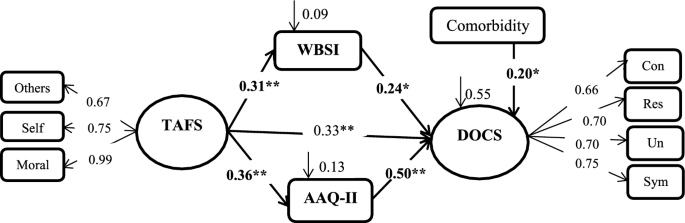
(2025): "This study emphasizes the importance of self-regulatory strategies, particularly in the manifestation of depressive symptoms, to link thought-action fusion to the OCD symptoms. Furthermore, this study offers further evidence in favor of the metacognitive model of OCD about the role of the meaning and power of intrusive thoughts, as dysfunctional metacognitive beliefs conceptualized as thought-action fusion, in OCD and adds new literature regarding self-regulatory strategies employed to address these dysfunctional metacognitive beliefs, particularly in the context of depression."
Michael DeMarco, PhD
Review
Michael DeMarco, PhDReview
Michael DeMarco, PhDReview

Try an ABC exercise